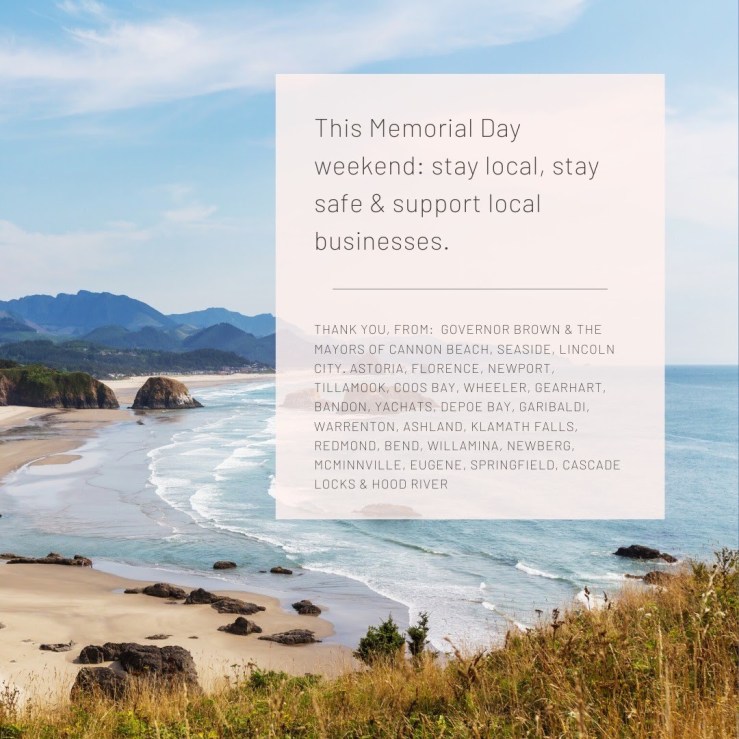
Please Stay Close to Home This Memorial Day Weekend to help reduce the spread of Covid-19 throughout Oregon. Our coastal communities thank you.

Southwest Hills Neighborhood Association
Please Stay Close to Home This Memorial Day Weekend to help reduce the spread of Covid-19 throughout Oregon. Our coastal communities thank you.
We have successfully made it through the first weekend of Lane County’s Phase 1 reopening that began May 15. As we focus on moving forward, it is more important than ever that we work together as a community to support our local businesses in a way that is respectful and safe for all. We’ll all need to be prepared for things to be a little different as we venture back out into the world, including being patient as we figure out this new phase together.
Please wear your masks for the safety of our neighbors who are – and have been – putting their health and lives at risk to bring you services. Please continue physical distancing. Please practice kindness and grace with those around you as we are all experiencing this process in our own way.
Below we’ve provided information on some frequently asked questions.
The CDC and the Oregon Health Authority strongly recommend wearing face coverings in public. As Oregon reopens and restrictions gradually lift on businesses and public spaces, it may be difficult to ensure you can stay six (6) feet away from others at all times.
Additionally, some businesses may choose to require face coverings, and certain businesses and transit have specific requirements. See detailed mask and face covering guidance for businesses, transit and the public.
Yes. To protect yourself and others, continue to practice physical distancing of at least six (6) feet between you and people you don’t live with.
The City of Eugene is providing information and other assistance to help employers operate under the State of Oregon’s Phase 1 guidelines. Our business assistance team welcomes questions about operating under the guidelines, as well as suggestions from employers on how municipal government can support the restarting of businesses and the economy. Learn more about our Business Support or email the business assistance team.
If you have concerns that a business is not properly adhering to the Governor’s Executive Orders regarding physical distancing of employees in the workplace, you can submit a form through Oregon Occupational Safety and Health Administration (OSHA).
The Oregon Department of Agriculture (ODA) is the lead agency related to grocery and convenience stores. Consumer complaints regarding customer behavior or a lack of customer physical distancing in the retail environment should be directed to the ODA.
Once you have reached out to these state agencies, if you would like to continue to pursue your business-related concern locally, you can contact the Lane County Non-Emergency COVID-19 Call Center at 541-682-1380 or email corona-info@lanecountyor.gov. They strive to be responsive with a strong emphasis on education.
Community members should refrain from calling 9-1-1 if they have non-emergency needs. If you have a complaint about failure to follow the Governor’s Executive Order that is not related to a business, please contact your local city government or law enforcement provider using their non-emergency phone numbers. If you live in unincorporated Lane County, please call the call center number during business hours.
Child care providers that are ready to meet the state’s new rules are allowed to reopen. These rules, which apply statewide to all counties, were released last week.
Child care centers have to limit how many children come into contact with other youth and how many adults associate with each group of kids. They’ll also have to keep careful logs of when children and adults come and go so that health officials can trace who has been exposed if anybody gets sick.
Not yet. Counties need to demonstrate at least three weeks of low COVID-19 transmission rates during Phase 1 of reopening before they can apply to enter Phase 2. The current Phase 2 guidelines are still being developed and may allow for limited visits to nursing homes and other so-called congregate-care facilities.
Yes. In Phase 1, restaurants and bars are allowed to start serving seated meals.
To reopen, restaurants must ensure all tables are spaced at least six (6) feet apart. Groups eating together are limited to 10 people or fewer. Customers won’t be able to fill their plates at buffets or salad bars or to refill their drinks. Bar and restaurant staff need to wear face coverings. These businesses must close by 10 p.m.
Restaurants have been told they should encourage customers to call ahead or make a reservation. If there’s a long wait to be seated, customers may be asked to wait outside or in their cars.
You should check with your local restaurant to see if they are open during this time.
Small gatherings are permitted in Phase 1, but there are still strict limits. No more than 25 people can get together for any event, they have to stay at least six (6) feet apart and they all must be local to the area. While this is allowed, it is still recommended to practice physical distancing measures for everyone’s health and safety. Group sports are still prohibited.
Barbershops and salons can reopen in Phase 1. Haircuts must be by appointment only — no walk-ins allowed. Stylists and barbers will be required to abide by state guidelines such as tracking their customers’ names and contact information, wearing protective gear and keeping customers six (6) feet apart from one another. They are also required to screen patrons – they will ask questions about how you’re feeling to verify you have not exhibited symptoms related to the virus.
Yes, and State health officials strongly urge the use of masks for people who go out in public. Some people are required to wear face coverings to do their jobs, including health care workers and restaurant employees.
Some stores do require masks, and business owners may choose to deny entry to people who do not wear a mask.
The City of Eugene’s parks, trails and open spaces have remained open throughout the pandemic and continue to provide opportunities for physical activity while also providing opportunities for respite, health and wellness. Individuals are encouraged to use parks, trails and open spaces safely as they are able while following current guidance to maintain physical distance from others. Playgrounds, skateparks, outdoor sport courts and playground equipment, however, remain closed until further notice.
Gyms were allowed to reopen in Lane County beginning May 15 when we entered Phase 1. However, they must guarantee that patrons stay six (6) feet apart, and pools and showers remain closed. Contact sports are off-limits, and gyms are encouraged to ask their patrons to wear masks or other face coverings.
Gyms are also required to implement rigid sanitation protocols and track each person who works out and keep those records for at least 60 days.
After 21 days in Phase 1, counties continuing to meet the prerequisites may be able to enter Phase 2. Lane County’s ability to progress to Phase 2 relies on all of us working together and following all safety guidelines outlined for our gradual reopening.
As counties reopen across Oregon, we’re asking you to stay local and close to home—meaning less than 50 miles in urban areas.
We know it may be tempting to visit other parts of the state but staying local will help prevent the spread of COVID-19 to areas where it may not currently be circulating. Thank you for your efforts to keep your neighbors safe and healthy.

The gradual and incremental reopening of Oregon began earlier this month when Governor Brown allowed non-urgent medical procedures (beginning May 1) and recreation where physical distancing can be followed (beginning May 5 in some state park day-use areas and boat ramps, with an option for county/federal campgrounds). As Governor Brown has emphasized, Oregon’s phased reopening is guided by science and measurable data.
On Friday, May 15, two additional categories of business can reopen throughout Oregon:
Read more information on statewide guidance for reopening.
Lane County’s application detailing its ability to meet the state’s seven prerequisites for phased reopening was accepted and approved. This allows the County to move into Phase I on May 15.
During Phase I, the following will be allowed in Lane County:
The Oregon Health Authority has created downloadable signage in multiple languages to post in your business (OHA Guidance, Signage and Rules): “Clean hands save lives,” “Going out? Stay apart,” and “Do you have these symptoms?”
After a minimum of 21 days, Lane County may be able to enter Phase II if it continues to meet all prerequisites. The state will not move into Phase III until there is a reliable treatment or vaccine. See more details about the state’s three phases of reopening. It’s also important to remember the Governor’s plan may change and it could affect Lane County and Eugene.
“The Governor’s Reopening Oregon plan outlines a phased approach to safely restart public life and business based on science and data,” Eugene Incident Commander and Eugene Springfield Fire Chief Chris Heppel said. “Different types of businesses will reopen differently in each phase, so the community needs to be flexible as we reopen and work to keep everyone safe while resuming services.”
During the past eight weeks, Eugeneans and residents throughout Oregon have helped flatten the curve by following important guidelines. As the state reopens, it’s important to remember the risks and to continue to do our best to protect ourselves and one another. If we all follow these actions, we will help save the lives of our colleagues, neighbors, friends and family members.
See detailed guidance for the public.
When COVID-19 arrived in Oregon and Lane County, the City’s immediate response priorities were to help protect the health and safety of the community, support our public health partners and maintain essential services. As the pandemic evolved, the City directed resources to recovery measures, while also recognizing the need for a Long-term Community Recovery strategy to re-establish a healthy, functioning community that will sustain itself over time.
The City of Eugene is taking a “whole community approach” to long-term recovery that includes the social, economic and physical aspects of the city. To achieve long-term community recovery, the City of Eugene will start with a plan. This plan will focus on the period 12-24 months in the future to repair the damage caused by COVID-19. Learn more about the City’s long-term community recovery planning and watch the a recent City Council work session presentation and discussion.
The City of Eugene is working hard with our partners at Lane County and Springfield to ensure our community has important information about local, state and federal resources to help those who have been significantly impacted by the COVID-19 pandemic. See a list of Community Resources for physical and mental health, food, housing, businesses, employees, schools and children, as well as information in Spanish. Also learn how you can help.
Our partners also have a significant amount of information available online. Please visit these resources for the most up to date information:
This document was published May 6, 2020. For the most up to date information on the City’s work related to COVID-19, please visit our website.
This update provides information on the latest City activities and links to more information. For health and safety information about COVID-19 please visit Lane County Public Health’s website.
The good news about our flattened curve has everyone wondering when the Stay Home order will be lifted. Last week, Governor Brown outlined her plan for relaxing restrictions and reopening sectors of our community.
Most importantly, Governor Brown said the efforts to move forward with safely reopening Oregon will be gradual, incremental and based on science and data. The state has laid out seven pre-requisites that each county must reach before beginning Phase 1 of Reopening Oregon.
The seven pre-requisites include seeing a decline in COVID-19 cases, establishing a minimum testing regimen, creating a robust contact tracing system, identifying isolation facilities, finalizing and following the Oregon Health Authority’s guidelines to protect employees and consumers, having sufficient capacity to handle ongoing cases and having enough PPE on hand.
For a complete look at the Governor’s plan, please visit the State of Oregon website.
As the state rolls out more information this week and next we’ll keep you informed on what that means for you.
The Lane County Board of Commissioners met Tuesday to discuss its efforts and move forward to make sure we are in compliance with the state’s guidelines. After discussing a proposed Blueprint for Reopening Lane County, the Board endorsed the plan. You can watch a webcast and access the meeting materials including the Blueprint on the County’s website.
The Blueprint for Reopening Lane County will follow the Governor’s laid out phases. Once Phase 1 begins in Lane County it’s expected to last several weeks and to allow for small social gatherings and limited reopening of some businesses that are better positioned to maintain physical distance for their customers and employees. The County is preparing to apply to the state to start this phase but to be clear, as of today we are not yet in it. The Governor has stated the earliest Phase 1 may start in any county in Oregon is May 15. Lane County is positioning itself to be ready to begin Phase 1 as soon as the State allows and approves of our petition.
If all criteria are still being met the County would move to Phase 2, which would likely expand the number of people allowed to gather in groups, allow for non-essential travel and widen the types of businesses allowed to resume services. After several weeks of Phase 2, if all criteria are still being met, consideration would be made to move to Phase 3.
Phase 3 would be our new normal for the foreseeable future. It would likely allow an increase in gatherings, unrestricted staffing at work sites, visitors to assisted living facilities and increased seating at bars and restaurants.
We would like to caution everyone, though, that while it feels great to be thinking about a return to day-to-day life, the Governor’s plan may change based on new circumstances and that may require changes to the County’s plan.

Oregon will use a careful, step-by-step process to safely reopen our state based on clear public health criteria and signs our health care system is able to respond to a spike in new infections. Some counties will be eligible to begin limited reopening of additional business sectors as early as May 15 if they demonstrate they have met all requirements for reopening. These requirements include:
City staff, regional partners and members of our business community are working together on plans for our long-term community recovery. Our Emergency Operations Center team also now includes staff who are focusing solely on long-term recovery efforts. The developing plan includes business and employment recovery assistance, housing assistance and development support such as process improvements and public-led projects, as well as the City’s Cultural Services, events and activities that bring engaging experiences to the community. At the May 11 City of Eugene Council work session there will be a presentation to Council on this work. You can follow this link to find all upcoming public meetings.
It’s also important to keep in mind our ability to progress through these phases quickly depends upon every resident actively participating in keeping themselves healthy and continuing to make smart choices.
Practice good hygiene, wash your hands often and stay home if you are feeling sick. Wearing a mask in public and crowded areas is still recommended. We are still in this together.
For the past seven weeks, our COVID-19 Emergency Operations Center has been working to acquire necessary resources, coordinate logistics with our regional partners, maintain critical services and identify community needs to slow the spread of the novel coronavirus in Eugene.
We are proud of the work this team has done in a short amount of time, many serving outside of their normal scope of work to help manage the COVID-19 response in Eugene.
The work we’ve accomplished in our Emergency Operations Center is only part of the story. We are making progress in the fight to flatten the curve of this pandemic in our community with your help. Together we’ve slowed the spread of the virus by staying home and practicing physical distancing.
The City of Eugene is working hard with our partners at Lane County and Springfield to ensure our community has important information about local, state and federal resources to help those who have been significantly impacted by the COVID-19 pandemic. See a list of Community Resources for physical and mental health, food, housing, businesses, employees, schools and children, as well as information in Spanish. Also learn how you can help.
Wondering what’s open at the City? Get the latest information at City Services – What’s Open?
Our partners also have a significant amount of information available online. Please visit these resources for the most up to date information:
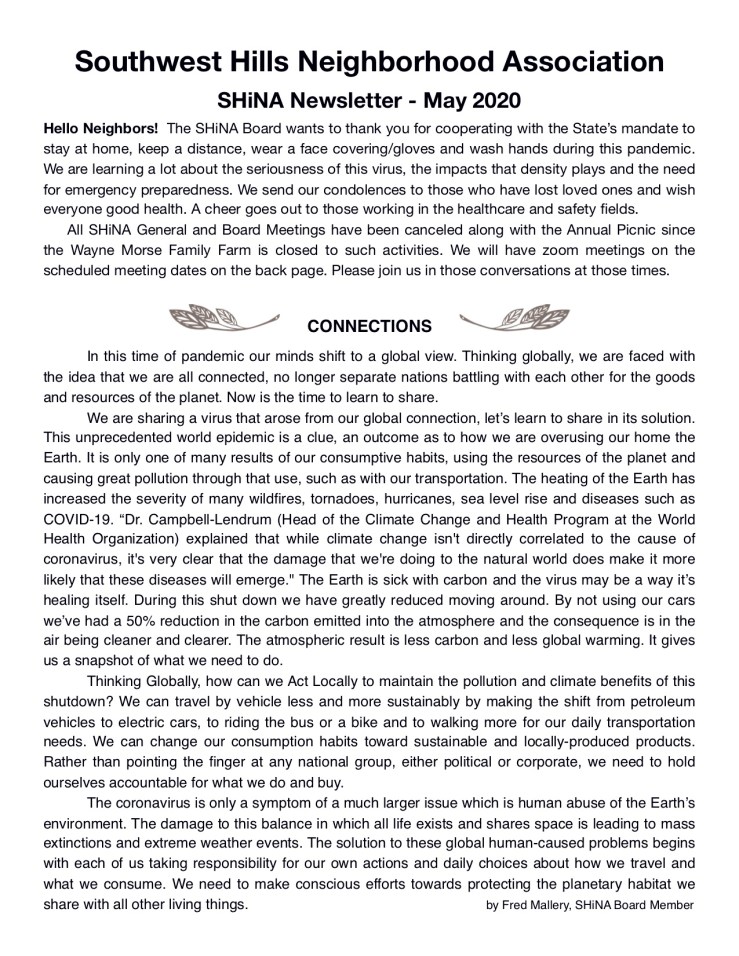
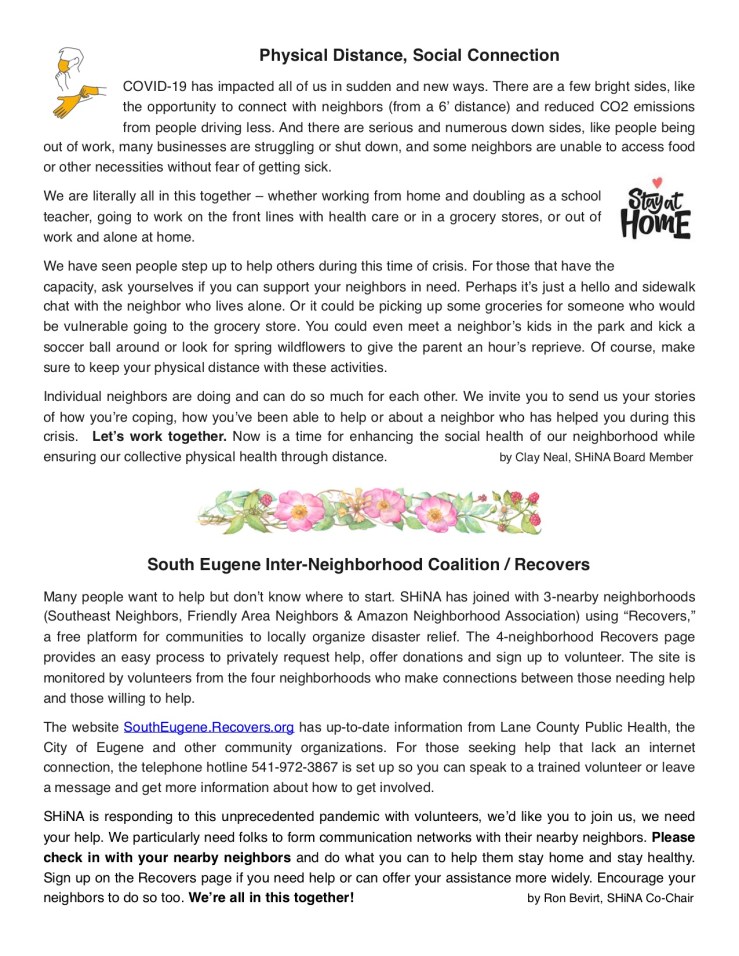
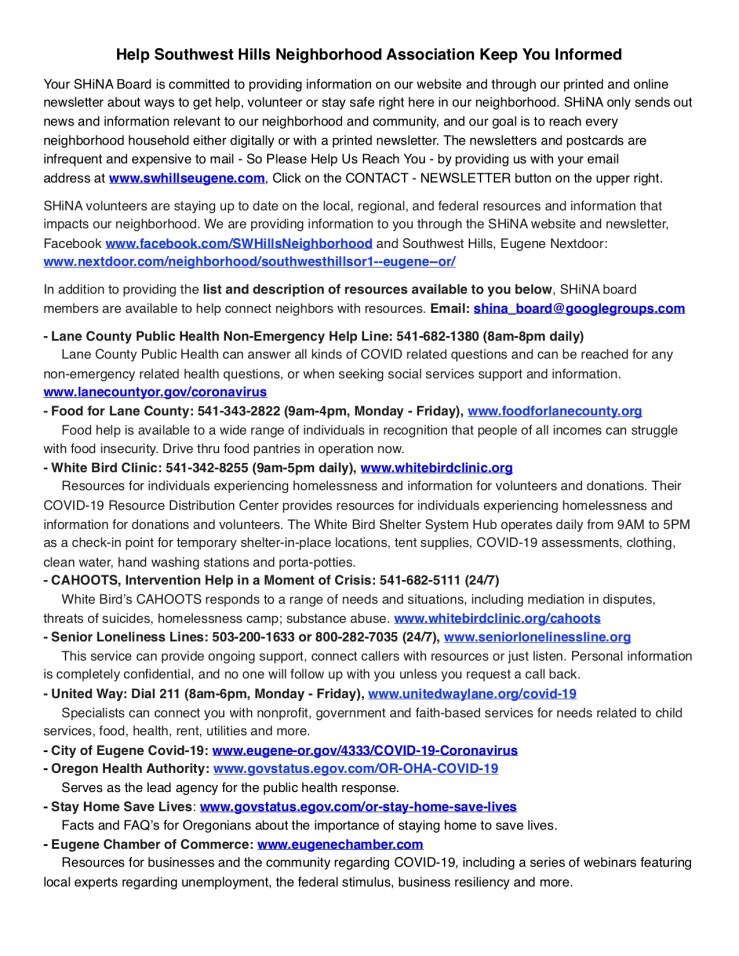
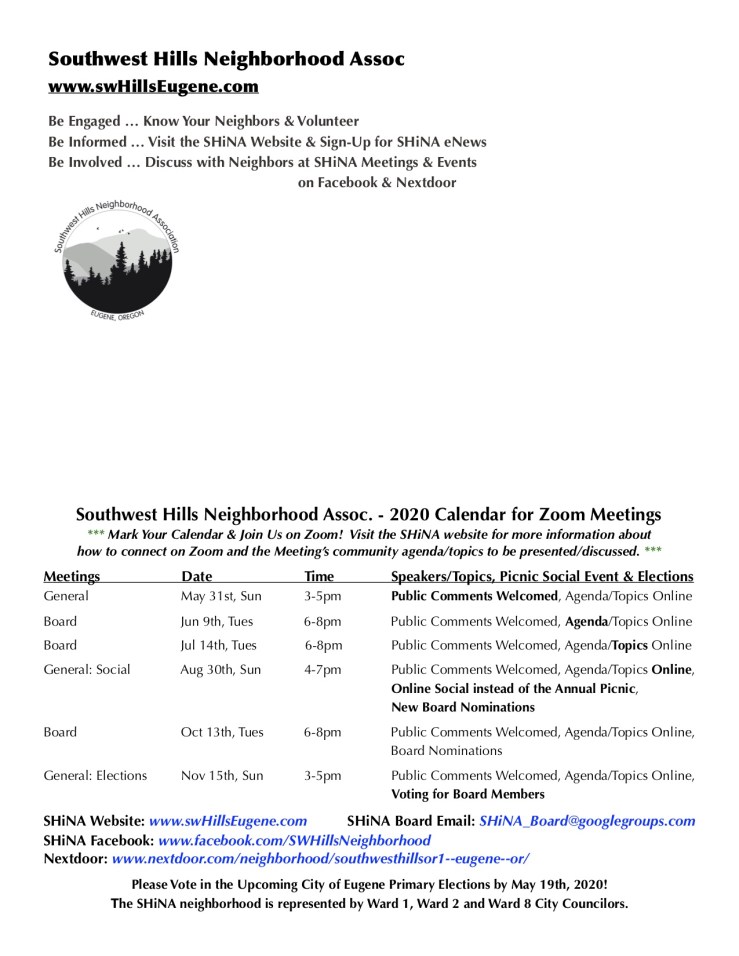
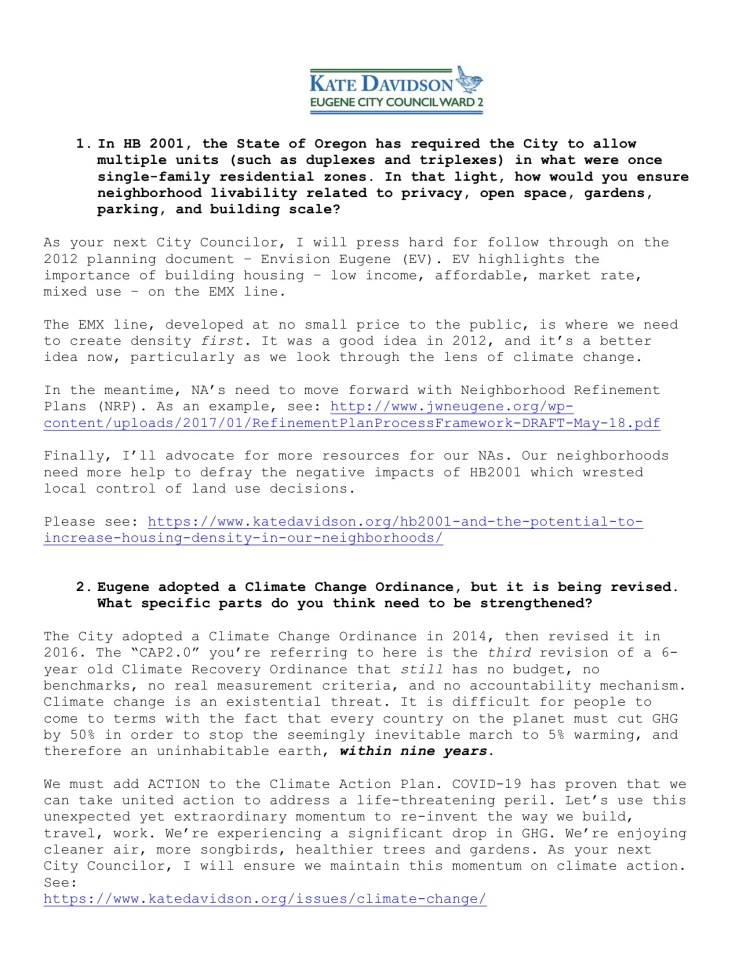
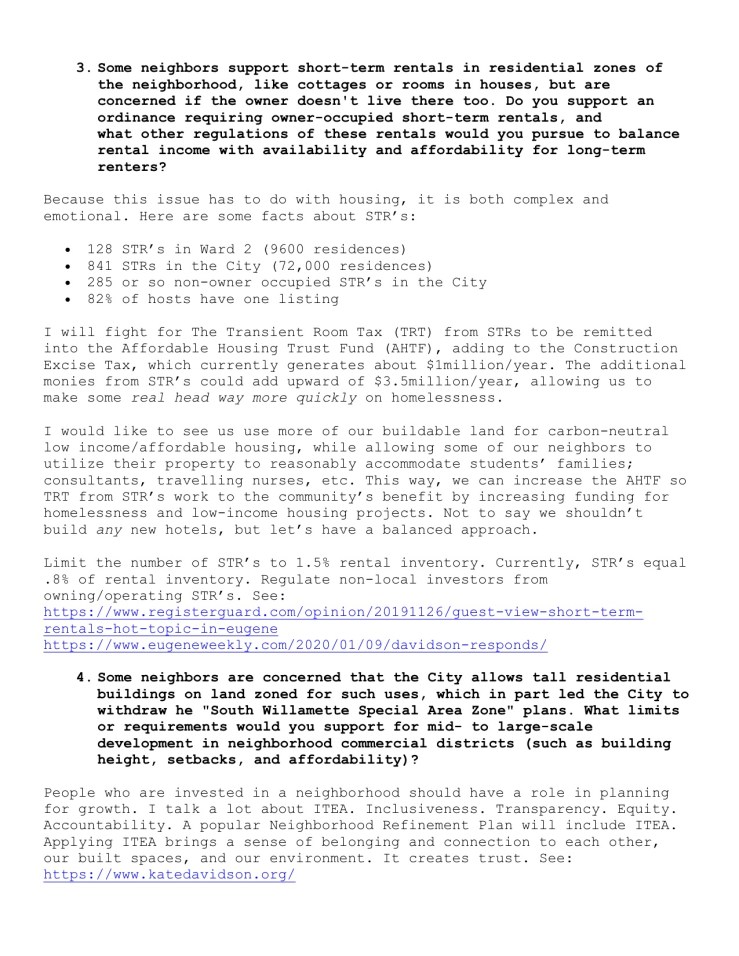
The SHiNA Neighborhood posed questions to the two candidates running for the Ward 2 City Council position to replace Betty Taylor. Here are their answers. You can click on the pages to view each candidates response as a PDF with higher resolution.
Here is the Q and A with Kate Davidson:
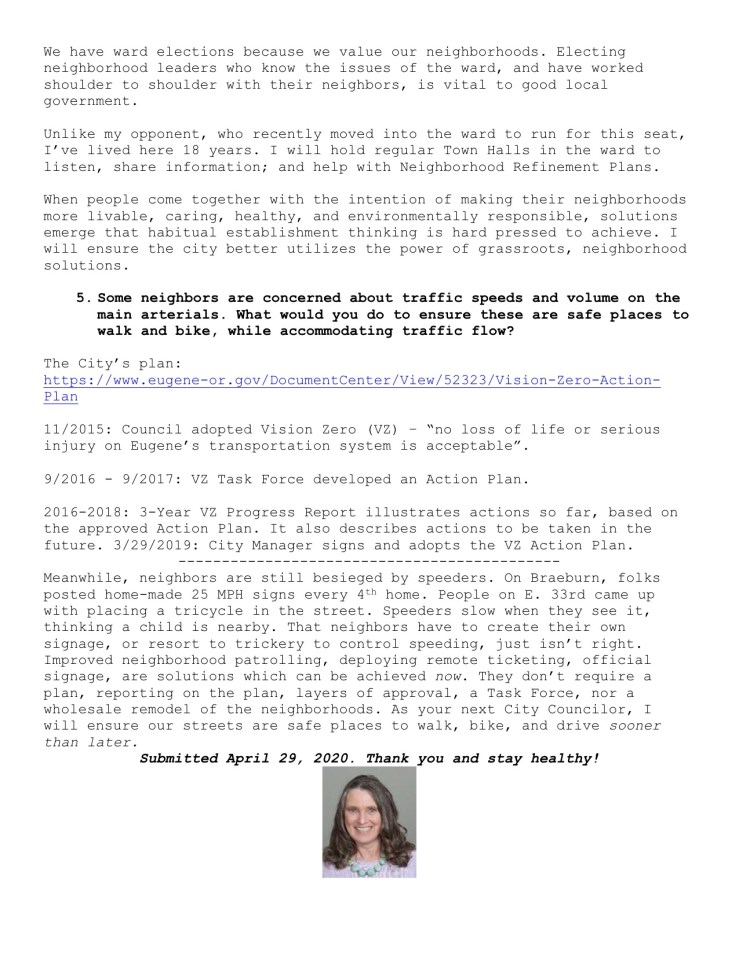
Here is the Q and A with Matt Keating:


The City of Eugene’s top priority continues to be the health and safety of the community as we move into the fifth week of our national collective emergency. We are in this for the long haul but we are in this together. There is a lot going on to keep our community safe and preserve our local hospitals’ capacities. This update provides information on the latest City activities and links to where you can find more information. For health and safety information and updates on COVID-19 please visit Lane County Public Health’s website.
In This Update:
– Economic Recovery
– Additional designated temporary shelter sites to open for unhoused in Eugene
– Help Your Community
– Using Trails and Outdoor Spaces Safely
– Resources for More Information
Economic Recovery
Eugene’s economic development staff are working hard with our partners at Lane County and Springfield to ensure our community has important information about federal and state resources. Our COVID-19 webpages includes an Info for Businesses section that is regularly updated as new information becomes available.
Eugene has conducted daily outreach to employers to understand their needs and ability to access federal resources, such as the Paycheck Protection Program and the Economic Injury Disaster Loan. We know the application process has been challenging and we are working with our regional partnerships to communicate these challenges to the federal level.
We are taking steps to help our businesses navigate this difficult time. Before the Governor ordered the closing of many businesses, the City of Eugene reached out to businesses that are recipients of the City’s loans to see how we could help. We offered to defer loan payment for two months to businesses that needed it.
We’ve also worked with restaurants in and near the downtown to create designated parking spaces so restaurant patrons can quickly access take-out services.
We are working to get businesses the resources they need so they can survive this shutdown and continue to be part of our community when things re-open.
The Eugene Area Chamber of Commerce has compiled a list of restaurants that are open for pick-up or delivery at this time, and several restaurants and businesses have started offering grocery delivery. Shopping at locally owned stores is one of the best things we can do to help our economy recover in the weeks and months to come. If you are wondering if it is safe to order take out, research has shown contracting the virus through food is unlikely. Food borne exposure to this virus is not known to be a route of transmission. It is still important to maintain physical distance from food delivery people.

Workers who are unemployed at this time can also find links to resources on our Info for Workers page, including unemployment insurance benefits, workers facing a layoff situation, and more.
As our region continues to respond to COVID-19, the City of Eugene, in conjunction with Lane County and White Bird, opened two designated temporary emergency sheltering sites the week of April 6 at Amazon and Hilyard community centers. This week, we mobilized a third temporary shelter site, Petersen Barn Community Center, and will provide space for up to six additional car and six tent camping sites.
The City of Eugene continues to focus on strategies that will “flatten the curve,” such as a distribution site for basic supplies, designated temporary shelter sites, outreach to unhoused individuals, and basic sanitation and hygiene. These strategies reduce the need for people to travel around the city to access basic needs and shelter. This work is consistent with CDC guidance on protecting people experiencing homelessness and the broader community from the spread of COVID-19.
Designated temporary shelter sites are locations where small groups of people (up to 10 people or six tents) can stay in tents or vehicles with appropriate physical distancing and will be supported with hygiene stations (portable restrooms and handwashing stations), food and supplies, and welfare check-ins. The locations also have privacy fencing in place to help support the security of the site. The sites are managed by White Bird and Carry It Forward, local homeless service providers.
Spaces in the sites are available by referral only. Individuals must go to the White Bird distribution site, at 341 E 12th Ave., first to be assigned to a designated temporary shelter location. The White Bird distribution site is open seven days per week from 9 a.m. to 5 p.m.
Individuals who are already safely sheltering in place elsewhere are advised to stay where they are and access supplies through the distribution site or outreach teams rather than relocating to these sites.
Basic Sanitation and Hygiene Stations Continue – With a focus on increasing hygiene in the community to limit the spread of COVID-19, the City of Eugene has continued to add to the number of publicly available restrooms. The City’s Emergency Operations Center distributed nearly 40 portable restrooms around the city. There are also approximately 50 handwashing stations throughout Eugene. View all of the portable restrooms and handwashing station locations through our online mapping portal. According to the Centers for Disease and Control, regular handwashing is one of the best ways to remove germs, avoid getting sick, and prevent the spread of germs to others, including COVID-19.
Outreach to Support Basic Needs and Stay-In-Place – The City has been conducting outreach to unhoused individuals to ensure basic needs are being met for those experiencing homelessness, allowing them to stay in place as much as possible during this emergency. Outreach teams are canvassing the parks and rights of way throughout Eugene and are passing out food, water, gear, hygiene supplies, and education and up-to-date information on COVID-19.
You can directly support your fellow community members by donating blood. To support social distancing, appointments are required. With thousands of blood drives cancelled during the COVID-19 pandemic, the American Red Cross is working hard to open new donation sites. In the meantime, please search 14 days out or beyond. The need for blood is constant – patients need your help. Find a blood drive near you through the American Red Cross or Bloodworks Northwest.
There are many ways to volunteer at this time. United Way of Lane County has a webpage with information about all the ways community members can volunteer their time and abilities right now.
Trails and outdoor spaces are seeing major spikes in usage across the country, as individuals and families look to these assets for daily physical activity and mental respite in the wake of COVID-19. The Rails to Trails Conservancy has put together a list of resources that offer guidance on how to be safe in the outdoors. Be safe and be healthy!
If you plan to visit a park, strict adherence to physical distancing and equipment closures are mandatory. Keep the “space” in parks and open space:
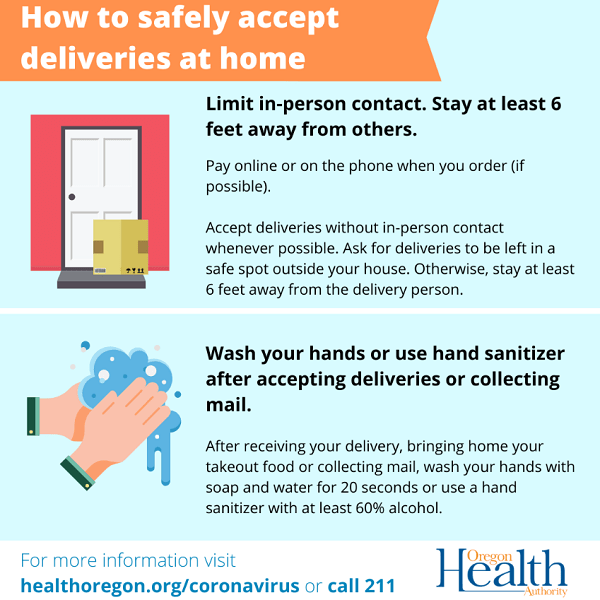

The City of Eugene and our partners have a significant amount of information available online. Please visit these resources for the most up to date information.
Multnomah, Washington and Clackamas counties have teamed up to create a Coronavirus Checker, which allows you to check your symptoms if you feel you may have the virus.

Topos Covid-19 Project – A multidimensional view of Covid-19s Impact in Counties across the US. Mapping the latest data on the outbreak with vulnerable populations, current policy, and health care resources.
You can view the levels of Covid-19 infections by county, throughout the country. Showing in more granular detail the areas that are hardest hit by the virus.

The weather forecast for the next several days shows that we can expect some warm, sunny weather. We all have essential reasons to go outside, like grocery shopping and taking a walk to improve our mental health.
Even as the weather continues to improve, remember that the Stay Home, Save Lives order is working to slow the spread of coronavirus. We must continue our commitment, even in nice weather. The better we do, the sooner we can get through this.
Here are a few tips and reminders about how to stay safe when it’s sunny.

New data in Oregon shows that the number of cases is not rising steeply, another reminder that the Stay Home, Save Lives effort is working and is likely to be in place at least through mid-May. For those wondering about when the executive order will be lifted, public health officials have made it clear we need to see a steady two-week decrease in case counts before the order can be reevaluated. Returning to life as it was before the pandemic will need to happen gradually, not all at once.
The Institute for Disease Modeling released updated projections over the weekend that estimate that the social gathering/physical distancing measures implemented in Oregon have prevented approximately 18,000 coronavirus cases and 500 hospitalizations. The analysis indicates statewide efforts in Oregon have reduced transmission by 55-75 percent. Nice work, everyone!
Governor Brown announced that in-person public education classes throughout Oregon are canceled through the end of the school year, thereby extending the executive order that previously was scheduled to end on April 28. She directed K-12 school districts, community colleges, and universities to complete the final weeks of the regular academic year by supporting their students through distance learning that is already underway. Oregon Department of Education have been working diligently with local school districts to implement guidelines for distance learning.
Student, Family and Educator Resources
– Distance Learning for All: Resources and Guidance
– Overview of Guidelines for Distance Learning
– A Guide for At-Home Learning (English)
– A Guide for At-Home Learning (Spanish)
– District Distance Learning Planning Tool
– Distance Learning: Sample Instructional Day (K-12 Overview)
– Graduation Pathways for Seniors (NEW)
– District-by-District Access to Meals for Students
– Mental Health and Social Support Resources for Migrant and Non-English Speaking Families
– Supporting Emergent Bilingual Students with Distance Learning
– How to Support LGBTQ+ Youth
– Resources for Youth Suicide Prevention
– How to Support Children and Teens Through Loss and Trauma
– PPS: Supporting your student’s emotions during the coronavirus crisis
– Teach From Home (Educator Resources)
Resources to support food access for kids, teens, college students and families
With schools and colleges closed, we know access to food has been interrupted for many Oregon families. Partners for a Hunger-Free Oregon has a roundup of resources to support youth, college students and families during this time, including an interactive map of where to find meals for kids.
For those seeking access to school meals from Oregon’s public schools, free meals are available to all children ages 1 to 18 to pick up “grab and go” style.
To receive a school meal:
– You do not have to attend that specific school or district to have access to these meals.
– No application or income verification is needed.
– Children do not need to be present when picking up a meal, because the USDA recently waived this requirement, but school districts will need to verify parent or guardian status.
The Oregon Department of Education is also maintaining a webpage with links to school district programs and plans for feeding kids during school closure.
 SHiNA
SHiNA 